
How to Meal Plan for a Week: A Beginner’s Step-by-Step Guide
It was a Wednesday, 6:15 pm. I was standing in front of an open fridge, cold air on my face, holding a half-empty jar of pickles and feeling genuinely angry at myself. This was the third takeout order that week — not because I couldn’t cook, but because I hadn’t decided what to cook until the exact moment I was already starving. Hungry people don’t make plans. They make phone calls to restaurants. I finally decided to learn how to meal plan for a week — and it changed everything.
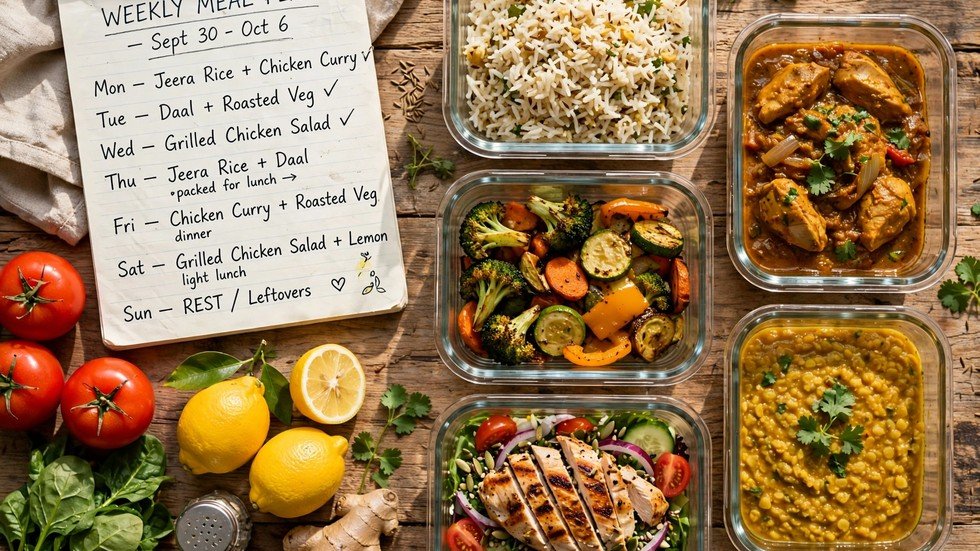
That weekend, out of pure spite toward my food bill, I sat down with a sticky note and wrote five dinners for the coming week. Nothing fancy. Monday: daal and rice. Tuesday: chicken curry. You know what happened? I spent less than half of the previous week’s food money, threw away almost nothing, and — the part I didn’t expect — I actually enjoyed cooking again, because the dreaded “what’s for dinner” question was already answered.
That sticky note turned into a habit I’ve kept for years. Meal planning sounds like something organized people do with color-coded spreadsheets. It’s not. It’s just deciding dinner before you’re hungry. If you’ve ever wondered how to meal plan for a week without a spreadsheet or stress, here’s the exact system — built for beginners who’ve never planned a single meal.
Quick Stats
- Planning Time: 20–30 minutes, once a week
- Meals Covered: 5 dinners (plus lunches from leftovers)
- Optional Prep Session: 60–90 minutes on the weekend
- Typical Savings: 20–30% off the weekly food bill
- Skill Level: Absolute beginner
What You’ll Need
Almost nothing, which is the beauty of it:
- A notebook, or any free notes app — this is your planning HQ. Fancy meal-planning apps exist, but paper works just as well and you’ll actually stick with it.
- Your calendar — the plan has to fit your real week, not an imaginary one.
- Last week’s grocery receipt (optional) — eye-opening the first time; it shows exactly where your money went.
- Food storage containers — a handful of airtight containers for prepped ingredients and leftovers. Glass is great; anything with a sealing lid works.
- One honest look in your fridge, freezer, and pantry — you’ll do this every week in Step 2.
Step-by-Step Method
Step 1: Look at your actual week before you plan a single meal. Pull up your calendar. Which nights are late? Who’s eating out? Is Friday always pizza night at your house? A meal plan that ignores your real schedule dies by Wednesday — I know, because my first three plans did exactly that. Mark the nights you genuinely won’t cook, and plan around them. Five planned dinners plus two flex nights beats seven ambitious plans you abandon.
Step 2: Take inventory — fridge, freezer, pantry. Before you write a single grocery item, look at what you already own. That half-bag of lentils, the chicken thighs in the freezer, the carrots going soft in the drawer — these become the backbone of your week. This step alone probably saves you 15% on groceries, because most of us rebuy things we already have. I keep a running “use first” shelf in my fridge for anything that needs eating soon.
Step 3: Pick just 4–5 dinners, not 7. Here’s the beginner mistake: planning seven brand-new recipes. You’ll burn out by Thursday. Plan four or five dinners, and let the other nights be a leftovers night and an eating-out or breakfast-for-dinner night. Give your week loose themes to kill decision fatigue — Meatless Monday, curry night, pasta night, stir-fry night. Themes sound silly until you realize you’ve eliminated the hardest part: choosing.
Step 4: Repeat proteins, vary the meals. This is the quiet money-saving engine of meal planning. Buy chicken once, eat it three ways: roast chicken Monday, chicken fried rice Wednesday from the leftovers, chicken wraps Friday. Same with mince, lentils, eggs. You buy in economical quantities, waste almost nothing, and never feel like you’re eating the same dinner twice — because you’re not.
Step 5: Write your grocery list grouped by store section. Produce together, meat together, pantry together, dairy together. This sounds trivial, but it changes your shopping completely: one clean pass through the store, no backtracking, and dramatically fewer impulse buys. I write my list in the order I walk the aisles. The people zigzagging past me with overflowing carts are buying twice as much as they need.
Step 6: Do a 60-minute weekend prep session (optional but powerful). You don’t have to cook whole meals ahead. Just do the boring parts: wash and chop vegetables, marinate proteins, cook a big pot of rice or grains, mix a sauce. Put on music, set a timer for an hour. When Tuesday-night-you opens the fridge to find chopped onions, marinated chicken, and cooked rice waiting, weeknight cooking stops feeling like cooking and starts feeling like assembly.
Step 7: Cook, cool, store, and label. When you cook, make a little extra — future lunches. Cool food within two hours (don’t leave the pot on the counter all evening), portion into containers, and label with the date. Cooked meals keep 3–4 days in the fridge. That little date label is the difference between confidently grabbing lunch and suspiciously sniffing a container on Friday.
Step 8: Protect your flex night. Friday is my flex night: whatever’s left becomes a buffet, or we do breakfast-for-dinner (omelettes clean out a fridge like nothing else). This night is load-bearing — it absorbs the meals you skipped, uses up the last vegetables, and means you start the next week with an empty fridge instead of a science experiment. Zero waste, zero guilt.
Pro Kitchen Tips
- Start with dinners only. Don’t try to plan breakfast, lunch, dinner, and snacks in week one. Master dinners for a month; the rest follows naturally once the habit exists.
- Keep a “greatest hits” list. Write down the 10–12 meals your household actually likes and rotate through them. New recipes are for weekends when you have energy, not for the plan that has to work every week.
- Frozen vegetables are a meal planner’s secret weapon. Already chopped, never wilt, and nutritionally equal to fresh. Peas, spinach, mixed veg — they rescue countless planned meals.
- Put the plan where everyone can see it. On the fridge, on a whiteboard, in the family group chat. A plan nobody else knows about gets derailed by someone suggesting takeout on Tuesday.
- Plan one 15-minute emergency meal into every week. Keep the ingredients for something dead simple (like a masala omelette or fried rice) always on hand. It’s your safety net for the night everything goes sideways — and it beats the takeout app.
Troubleshooting Advice
- My plan fell apart by Wednesday. You almost certainly planned too ambitiously — seven new recipes, no flex night, no margin for real life. Scale back to four or five familiar dinners plus a leftovers night. A boring plan you follow beats an exciting plan you abandon.
- I’m bored eating the same things. Switch from planning full meals to planning components: cook grains, proteins, and two sauces, then mix and match all week. Same chicken becomes a wrap, a rice bowl, and a salad depending on the sauce. Variety comes from combinations, not from cooking seven different recipes.
- My fresh produce wilted before I used it. Plan delicate greens and herbs for Monday–Tuesday, and hardy vegetables (carrots, cabbage, potatoes, frozen veg) for Thursday–Friday. And store herbs like flowers — stems in water in the fridge — they last twice as long.
- I forgot a key ingredient mid-week. Keep a permanent pantry checklist: oil, rice, lentils, canned tomatoes, onions, garlic, ginger, basic spices, eggs. If these are always stocked, a forgotten item is an inconvenience, not a disaster — you can always pivot to a pantry meal.
- Takeout still tempted me on tired nights. Stop fighting it and plan for it: one planned takeout night a week, guilt-free. And keep that 15-minute emergency meal stocked. Most takeout orders happen because there’s “nothing to eat” — make sure there’s always something.
FAQs
How do I meal plan on a tight budget?
The inventory step (Step 2) is your biggest lever — most tight budgets leak money on duplicate purchases, not expensive ingredients. Then: buy seasonal produce, repeat one or two proteins across the week, and lean on lentils, eggs, and rice, which are the cheapest complete meals on earth. My cheapest planned weeks are always the lentil-and-egg-heavy ones, and nobody complains.
What if I genuinely hate leftovers?
Then don’t plan leftovers — plan “planned-overs.” There’s a real difference. Nobody wants Thursday’s curry reheated as Thursday’s curry. But roast chicken becomes Friday’s wraps, which becomes Saturday’s fried rice, and each one feels like a different meal because it is one. Cook components, not repeats, and the leftover problem disappears.
How long does prepped food stay safe to eat?
Cooked meals keep 3–4 days in the fridge at or below 4°C — so a Sunday prep covers you through Wednesday or Thursday, and you cook fresh once more mid-week for the rest. Reheat until steaming hot throughout. And the golden rule: when in doubt, throw it out. No planned meal is worth a ruined week.
Start this Sunday. Not next Sunday — this one. Twenty minutes, a sticky note, five dinners. It won’t be perfect; your first plan never is. Mine had Tuesday’s curry scheduled on a night I worked late, and we ordered pizza anyway. But the other four nights worked, the grocery bill dropped, and the 6pm panic went quiet. An imperfect plan you actually follow beats a perfect system you never start — every single time.
You might also like: 15-Minute Chicken Fried Rice That Beats Takeout