How to Fix a Broken Curry or Split Sauce: Troubleshooting Guide
There is a special kind of panic that hits when you lift the lid and see it: the curry you spent an hour on has split. But don’t throw it out — this guide shows you how to fix broken curry with a few simple tricks. Guests are coming in twenty minutes, and you’re about to save dinner.
I’ve been there more times than I’ll admit — the yogurt curry that curdled at a dinner party, the white sauce that turned to scrambled eggs in front of my mother-in-law. Here’s what I learned across all those disasters: a broken curry is almost never ruined. It’s just chemistry that went sideways, and chemistry can be steered back. This guide explains why splits happen and gives you six fixes that actually work, in order from simplest to most dramatic.
Quick Stats
- Reading Time: 9 minutes
- Fixes Covered: 6 proven rescue methods
- Skill Level: Beginner-friendly
- Success Rate: Roughly 9 out of 10 splits are fully fixable
- Golden Rule: Never throw it out before trying Fix #1
What You’ll Need
Keep these within arm’s reach whenever you cook dairy-based or emulsified sauces:
- A whisk — not a spoon. A whisk’s wires shear the sauce into tiny droplets, which is exactly what re-emulsification needs.
- An immersion blender (optional but mighty) — the nuclear option for grainy masalas. Ten seconds transforms texture.
- Cornstarch or plain flour — for the slurry fix. A tablespoon mixed smooth with cold water.
- Plain yogurt, at room temperature — cold yogurt hitting hot curry is the number one cause of splits. Room-temperature yogurt is prevention and cure.
- Ice cubes — sounds strange, works brilliantly. More on this below.
Why Curries Split: The 60-Second Science
A curry sauce is an emulsion — tiny droplets of fat suspended in water-based liquid, held together by proteins and starches. It’s a fragile truce. Three things break it:
Too much heat. Boiling a yogurt or cream-based curry scrambles the dairy proteins, which clump together and squeeze out fat. This is the most common cause, full stop. Dairy curries should simmer gently, never boil hard.
Cold dairy into hot curry. Dropping fridge-cold yogurt into a bubbling pot shocks the proteins into seizing. It’s the thermal equivalent of jumping into ice water — everything contracts at once.
Acid plus heat plus time. Tomatoes, tamarind, and lemon are acids. Acids encourage dairy proteins to curdle, especially when combined with high heat. This is why tomato-yogurt curries are the most split-prone dishes in desi cooking.
Understanding this tells you how to fix broken curry: reduce heat, stabilize temperature, and re-emulsify with mechanical force or added starch.
The 6 Fixes, In Order
Fix 1: Take It Off the Heat and Whisk (30 seconds)
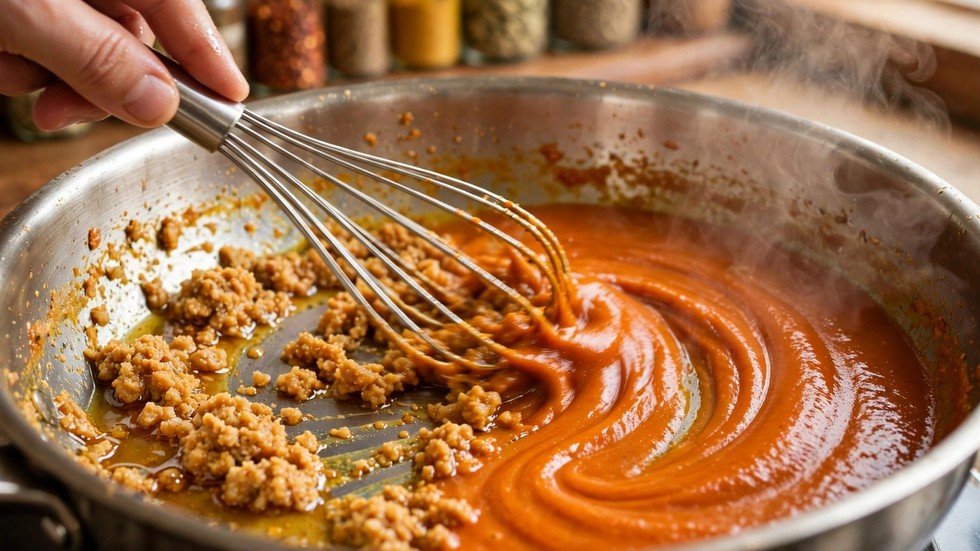
The moment you notice splitting, pull the pan off the burner and whisk vigorously for 30 seconds. That’s it. Early-stage splits — where the oil is just starting to bead at the edges — often come back together with nothing more than removed heat and agitation. The proteins haven’t fully set; they just need coaxing.
This fixes maybe a third of all splits. Always try it first.
Fix 2: The Ice Cube Shock
Drop two or three ice cubes into the curry and stir. The sudden temperature drop stops the proteins from tightening further, and the small amount of water helps loosen the sauce. It sounds like folk magic, but the logic is sound: splitting is proteins contracting under heat, and rapid cooling interrupts the contraction.
I was skeptical until a catering cook showed me this at a wedding where the raita-curry for two hundred guests started splitting. Ice cubes, stir, saved.
Fix 3: The Starch Slurry
Mix one tablespoon of cornstarch (or plain flour) with three tablespoons of cold water until completely smooth — no lumps, or you’ll trade one texture problem for another. With the curry on low heat, drizzle in the slurry while whisking constantly. Within a minute or two, the starch swells and physically holds the emulsion together.
Why it works: Starch molecules are long chains that tangle around fat droplets and keep them suspended. It’s the same reason gravy thickened with flour doesn’t split.
Use cornstarch for the cleanest result; flour works but can taste raw if undercooked, so simmer two extra minutes after adding it.
Fix 4: Temper Room-Temperature Yogurt Back In
If yogurt caused the split, more yogurt — handled correctly — can fix it. Take the curry off the heat and let it cool for two minutes. Whisk two or three tablespoons of room-temperature plain yogurt until completely smooth, then add a spoonful of the hot curry to the yogurt and mix (this is tempering — it gently raises the yogurt’s temperature). Now stir the warmed yogurt back into the pot, whisking all the while.
The key mistake people make is adding cold yogurt straight from the fridge into a hot pot. That’s what caused the problem; don’t repeat it as the solution.
Fix 5: The Immersion Blender Reset
For grainy, separated masalas where the texture is the main problem, an immersion blender is transformative. Let the curry cool slightly, then blend for 10–15 seconds directly in the pot. The blades smash everything into a uniform emulsion — oil, solids, liquid, all forced back together at microscopic scale.
This changes the texture (it’ll be smoother than the original), so it’s best for curries where smoothness is welcome: daals, makhani-style gravies, lentil soups. For a chunky karahi where you want distinct pieces, use it sparingly — just a few pulses.
Fix 6: Strain and Rebuild (The Last Resort)
When nothing else works — the sauce is thoroughly grainy and refuses to come together — strain it. Pour the curry through a fine sieve, pressing the solids. You’ll get a thin liquid and a pile of solids. Now rebuild: heat a spoon of fresh oil, return the liquid to the pan, whisk in a starch slurry (Fix 3), and simmer gently until it thickens into a proper sauce. Fold the solids back in.
It’s fifteen minutes of work, but it has saved curries I was certain were dead. The flavor is all still there; only the structure broke, and structure can be rebuilt.
Prevention: Stop Splits Before They Start
Fixes are good; not needing them is better. Four habits prevent nearly all splits:
Temper your dairy. Yogurt, cream, and coconut milk should be room temperature before they meet heat, and they should meet it gently — stirred in off the boil, never dumped into a rolling boil.
Simmer, don’t boil. Once dairy is in, keep the curry at the gentlest simmer. If you see vigorous bubbling, the heat is too high. This single habit prevents more splits than all six fixes combined.
Add acid carefully. When a recipe has both tomatoes and yogurt, cook the tomatoes down fully first, lower the heat, then add tempered yogurt. Giving the acid and dairy separate stages keeps them from fighting.
Stabilize with starch early. A spoon of besan (gram flour) whisked into yogurt before adding it — the classic kadhi technique — makes the dairy nearly split-proof. The starch shields the proteins from heat shock.
Pro Kitchen Tips
- Act fast. A split caught in the first minute is ten times easier to fix than one that’s simmered broken for twenty minutes. The proteins keep tightening with time and heat. Whisk first, think later.
- Keep a “rescue kit” mindset. Whisk, cornstarch, and room-temp yogurt cover 95% of emergencies. I keep cornstarch right next to the stove now, not buried in the pantry.
- Taste before you fix. Sometimes what looks like a split is just a curry that needs its final simmer — oil naturally rises in dishes like karahi and rogan josh, and that’s correct, not broken. If it tastes good and the texture is right, leave it alone.
- Document your disasters. I keep a notes file of every split: what dish, what I did, what fixed it. Patterns emerge fast. Mine told me I always split yogurt curries on high heat — a habit I broke in a week once I saw it written down.
- Serve with confidence. A rescued curry that tastes great beats a “perfect” one every time. Nobody at the table knows about the ice cubes. Your secret is safe.
Troubleshooting Advice
- The sauce split AND tastes scorched. Fixing the texture won’t remove burnt flavor. If it’s mildly scorched, transfer to a clean pot without scraping the bottom (the burnt layer stays behind), then apply the fixes. If it tastes strongly burnt throughout, this is the rare genuinely unsalvageable case.
- Fix 3 made it gluey. Too much starch, or it cooked too long after thickening. Thin it with warm water or stock, a splash at a time, whisking. Next time, start with one teaspoon of cornstarch, not a tablespoon — you can always add more.
- It keeps re-splitting. The heat is still too high, or there’s an acid (tomato, tamarind, lemon) actively working against the dairy. Lower to the barest simmer, finish with the starch slurry, and serve promptly — some sauces are stable for serving but not for holding.
- Coconut milk split. Same fixes apply, but prevention differs: add coconut milk at the very end and never boil it. Light coconut milk splits more easily than full-fat; the extra stabilizers in some brands help, so check labels if this recurs.
- The immersion blender made it baby food. You blended too long. Next time, pulse in 3-second bursts and check texture between pulses. For chunky curries, scoop out the meat or vegetables first, blend only the sauce, then recombine.
FAQs
Can you fix a curry that split hours ago and was refrigerated?
Often, yes. Reheat it very gently — low heat, stirring often — and the fat will melt back in. If it stays separated, apply Fix 3 (starch slurry) or Fix 5 (immersion blender) during reheating. Cold actually helps here: the emulsion resets more willingly from a cold start than from a hot broken one.
Does adding more oil help a split curry?
No — this is the most common wrong instinct. A split curry already has its fat separated out; more oil just adds to the floating layer. You need emulsifiers (starch, protein) and mechanical action (whisking), not more fat.
Why does my yogurt always curdle but my cream doesn’t?
Cream has far more fat and different proteins — it’s naturally resistant to curdling, which is why it survives boiling. Yogurt is lean and acidic, so it’s fragile under heat. That’s also why the fixes focus on tempering and gentle heat specifically for yogurt-based dishes.
Every cook splits a curry eventually — it’s practically a rite of passage. The difference between a disaster and a dinner party story is just knowing how to fix broken curry. Whisk first, reach for the cornstarch second, and remember: the pan is not the enemy. It’s just chemistry, and now you know the formulas.
You might also like: 15-Minute Chicken Karahi for Busy Weeknights