How to Keep Fresh Herbs Alive for Weeks: 5 Methods That Work
Every desi cook knows the heartbreak. You buy a glorious bunch of coriander on Saturday, use half of it in Sunday’s curry, and by Wednesday the rest has dissolved into a sad green puddle at the bottom of your fridge drawer. I used to lose half of every bunch I bought. Over a year, that’s real money — and worse, it’s the reason so many weeknight curries end up garnish-less and dull.
Then I got stubborn about it. I tested every herb-storage trick I’d ever heard — the wet paper towel, the jar of water, the freezing, the whole circus — side by side, with dated labels, like a slightly unhinged science project. Five methods actually worked. The rest were myths, or so fiddly that nobody sustains them.
Here are the five methods that keep fresh herbs fresh, ranked from simplest to longest-lasting. Pick the one that fits your life.
Quick Stats
- Methods Tested: 9 total, 5 winners
- Reading Time: 8 minutes
- Herbs Covered: Coriander, mint, parsley (plus notes on basil and dill)
- Longest Result: 4+ weeks
- Cost: Practically zero — jars, paper towels, and bags you already own
What You’ll Need
Nothing fancy. Gather these once and you’re set for all five methods:
- Glass jars or glasses — old jam jars are perfect. You’ll stand herb bunches upright in water, like flowers.
- Paper towels or clean kitchen towels — the workhorse of herb storage. Slightly damp, never soaking.
- Plastic produce bags or zip bags — for tenting and wrapping. Reuse them; this isn’t single-use territory.
- A pair of scissors — for trimming stem ends. A clean cut drinks water better than a crushed one.
- Ice cube tray (optional) — for the freezer method.
Method 1: The Jar of Water (Best All-Rounder)
This is the method I use for coriander and mint ninety percent of the time, and it’s almost embarrassingly simple.
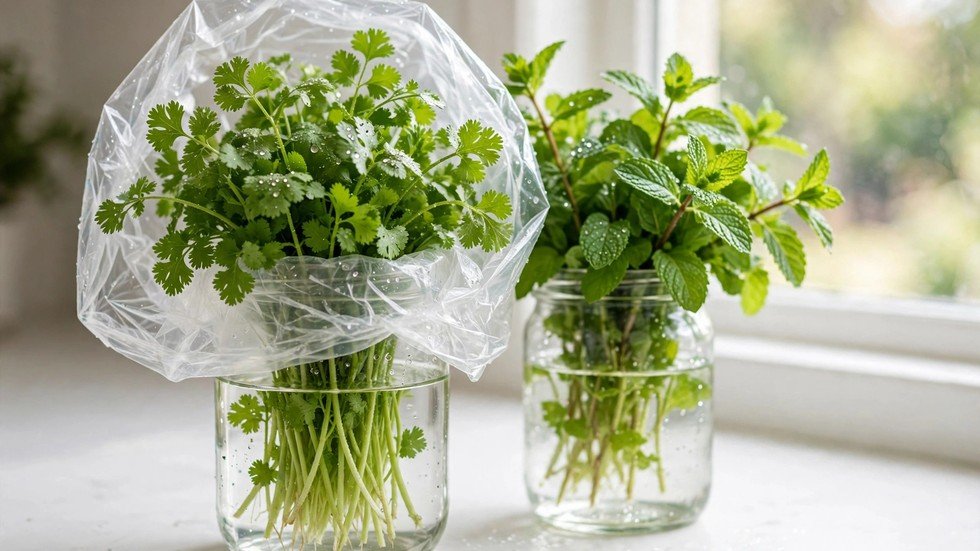
Trim half an inch off the stem ends — a fresh cut opens the stems so they actually drink. Fill a jar with an inch or two of cold water, stand the bunch upright in it like a bouquet, and loosely tent a plastic produce bag over the top. The bag is the secret: it traps humidity around the leaves while the stems drink from below. Store the whole thing in the fridge, and change the water every two to three days, or whenever it looks cloudy.
Why it works: Most herbs wilt because they lose moisture faster than their cut stems can replace it. The water jar solves the supply side; the tented bag solves the loss side. It’s the same principle as keeping flowers alive.
How long it lasts: Coriander stays perky for 2–3 weeks. Mint easily goes 3 weeks. Parsley can push past 3 weeks too.
Watch out for: Don’t cram the bunch in tight — air circulation prevents rot. And don’t skip the water changes; cloudy water means bacteria, and bacteria means slime.
Method 2: The Damp Towel Roll (Best for the Fridge Drawer)
If your fridge door has no room for jars, this is your method. Lay the herbs on a slightly damp paper towel, roll it up loosely like a sleeping bag, and slip the roll into a zip bag or container. Don’t seal it bone-tight — leave a little air.
The towel should feel like a wrung-out sponge: damp, not dripping. Too wet and the leaves rot; too dry and they wilt. Check once a week and re-dampen if needed.
Why it works: The damp towel creates a humid microclimate while absorbing the excess surface moisture that causes rot. It’s a balance act, and the towel does the balancing for you.
How long it lasts: 2 weeks for coriander and parsley, a bit less for delicate dill.
Watch out for: This method fails if the towel is sopping. Wring it well. I lost a whole batch learning that “damp” and “wet” are very different words.
Method 3: The Freezer — Oil Cubes (Longest Lasting)
For herbs you cook with rather than garnish with, the freezer wins outright. Chop coriander, mint, or parsley, pack it into an ice cube tray, cover with a neutral oil or a little water, and freeze. Pop the cubes out into a labeled bag.
Drop a cube straight into hot curry, daal, or soup — no thawing needed. The flavor is remarkably close to fresh in cooked dishes. I keep a bag of coriander cubes permanently in my freezer door; they’ve rescued more weeknight dinners than I can count.
Why it works: Freezing stops decay entirely, and the oil protects the leaves from freezer burn while preserving the fat-soluble flavor compounds.
How long it lasts: A month easily, two to three months without noticeable decline.
Watch out for: Frozen herbs go dark and limp when thawed — they’re for cooking, never for garnish. And label the bag. Mystery green cubes are a special kind of kitchen anxiety.
Method 4: Dry in the Fridge (Best for Hardy Herbs)
This one’s counterintuitive: for woody herbs like rosemary, thyme, and oregano, skip the water entirely. Wrap them dry in a paper towel, bag loosely, and refrigerate. These herbs are built to survive dry conditions — moisture is their enemy, not their friend.
Don’t use this for coriander or parsley; soft herbs need the humidity methods above. But if you buy thyme for one recipe and need it alive for the next three weeks, dry storage is the answer.
How long it lasts: 3–4 weeks for rosemary and thyme.
Method 5: The Revival Soak (For Herbs Already Wilting)
Not a storage method — a rescue mission. If your coriander has gone limp but isn’t slimy or dark, trim the stems and stand the bunch in ice water for 30–60 minutes. I’ve watched seemingly dead coriander stand back up like nothing happened. It works because the cells aren’t dead yet, just dehydrated; cold water rehydrates them fast.
This also works as a pre-storage step: give fresh bunches a 15-minute ice bath before Method 1 or 2, and they start their storage life fully hydrated. I do this with every bunch now.
When to give up: If the leaves are dark, translucent, or smell off, no method saves them. Compost and move on.
What About Basil? (The Exception)
Basil hates the cold — fridge temperatures turn its leaves black. Store basil like Method 1 but keep the jar on the counter, not in the fridge, changing the water daily. It’ll last a week to ten days at room temperature. This is the one herb where the fridge is the enemy.
Pro Kitchen Tips to Keep Fresh Herbs Fresh
- Buy smart at the store. Choose bunches with firm stems and no yellowing or slime at the base. Herbs that are already declining won’t revive no matter what you do — storage preserves, it doesn’t resurrect (except the ice bath, which is the one exception).
- Don’t wash before storing. Wash herbs right before use, not before storage. Surface moisture is the fastest route to rot. The one exception: a quick ice bath for revival, followed by a gentle shake-dry.
- Separate the bands. Those tight rubber bands around store bunches trap moisture and crush stems. Remove them the moment you get home and give the bunch room to breathe.
- Mint is nearly indestructible. Of all the herbs I tested, mint forgave every mistake — forgotten water changes, warm fridges, tight bags. If you’re nervous about the methods, practice on mint first.
- Grow a small pot. A windowsill pot of mint or coriander beats every storage method ever invented. Snip what you need, and the plant keeps producing. Mint especially grows like it has a personal grudge against empty soil.
Troubleshooting Advice
- Everything went slimy in three days. Too much moisture and not enough air. Your towel was too wet, your bag was sealed airtight, or the water went cloudy. Wring towels well, tent bags loosely, change water regularly.
- The jar method isn’t working. Check two things: did you trim the stems? And is the bag tented over the top? Skipping either one cuts the lifespan dramatically. Also make sure leaves aren’t sitting in the water — submerged leaves rot fast.
- Frozen cubes taste like freezer. You left them too long or skipped the oil/water covering. Use within two months, cover fully, and squeeze air from the storage bag.
- Herbs are fine but flavorless. Old stock, most likely. No storage method restores flavor that’s already faded. Buy fresh, store well, and use within the windows above.
- Dill keeps dying no matter what. Dill is the diva of herbs — delicate fronds, short life. Use the damp towel method and accept 7–10 days as a win. Or grow it; dill grows fast from seed.
FAQs
Can I store different herbs together in one jar?
You can, but keep strong-scented herbs apart — mint happily perfumes everything near it. I keep coriander and parsley together (they’re mild neighbors) and give mint its own jar. Wash the jar between refills.
Do these methods work for curry leaves?
Curry leaves are a special case: they freeze brilliantly (better than refrigerating) and keep for months frozen. For fridge storage, the damp towel method gives about two weeks. Don’t bother with the water jar — their woody stems don’t drink well.
Is it worth buying those special herb-keeper containers?
Honestly? A jam jar and a produce bag do the same job for free. The commercial keepers are just a jar with a water reservoir built in. Save your money for better herbs.
I haven’t thrown away a bunch of coriander in months, and my curries have the fresh green finish they always deserved. Start with the jar of water — it takes thirty seconds — and once you see how easy it is to keep fresh herbs fresh, you’ll wonder why you ever accepted the Wednesday puddle. The freezer cubes are the power move for later, once you’re converted.
You might also like: 15-Minute Masoor Daal Tadka