Knife Skills for Beginners: 5 Cuts Every Home Cook Should Know
These knife skills for beginners start with the claw grip — which I learned the hard way, by not using it. Twenty years ago, in my first real kitchen job, I was dicing onions with my fingertips sticking straight out like I was playing the piano, and the chef took one look, stopped the line, and physically curled my fingers under with his own hand. “Your knuckles are your guides,” he said. “The knife never touches skin if your knuckles lead.” I haven’t nicked a finger since, and that single correction taught me something bigger: knife skills aren’t about speed or talent. They’re about a handful of simple techniques that anyone can learn in one afternoon.
The five cuts in this guide — chop, dice, mince, julienne, and slice — cover about ninety percent of everything a home cook does with a knife. Master these and you’ll chop an onion in under a minute, cut vegetables that cook evenly, and stop dreading the cutting board. More than that, you’ll be safer: a sharp knife and good technique are a team, and I’ll explain exactly why below.
Before we start: you don’t need an expensive knife. You need one decent 8-inch chef’s knife that’s sharp. A sharp, cheap knife beats a dull, expensive one every single time.
Quick Stats for Knife Skills for Beginners
- Total time: 30–45 minutes of practice to learn all five cuts
- Difficulty: Beginner — no prior experience needed
- What you’ll learn: The claw grip, 5 essential cuts, why sharp knives are safer, knife safety rules
- Best for: Anyone who avoids recipes with “finely chop the onion”
What You’ll Need
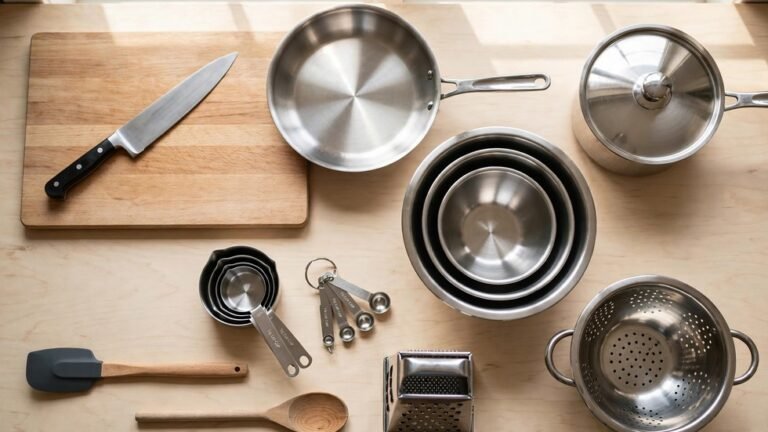
- An 8-inch chef’s knife: The workhorse. Its curved blade rocks for chopping and its length handles everything from herbs to butternut squash. This one knife does all five cuts in this guide.
- A sharp blade (hone or sharpen first): A dull knife is dangerous — I’ll explain the physics below. If your knife crushes a tomato instead of slicing it, it needs sharpening before you practice.
- A large, stable cutting board: Bigger than you think you need. Put a damp paper towel or thin cloth underneath so it can’t slide — a moving board is one of the most common causes of cuts.
- Vegetables to practice on: One onion, two carrots, a few cloves of garlic, a bell pepper, and a potato. Cheap, forgiving, and you get dinner out of the practice.
- A honing steel (optional but recommended): Keeps the edge aligned between sharpenings. Ten seconds of honing before each use makes a noticeable difference.
The Technique, Step by Step
Step 1: Learn the grip on the knife. Hold the handle with three fingers wrapped underneath, and pinch the blade itself between your thumb and index finger, right where the blade meets the handle. This “pinch grip” gives you control — holding only the handle is like steering a car with your fingertips. It will feel strange for exactly one onion. Then it will feel like the only sensible way to hold a knife.
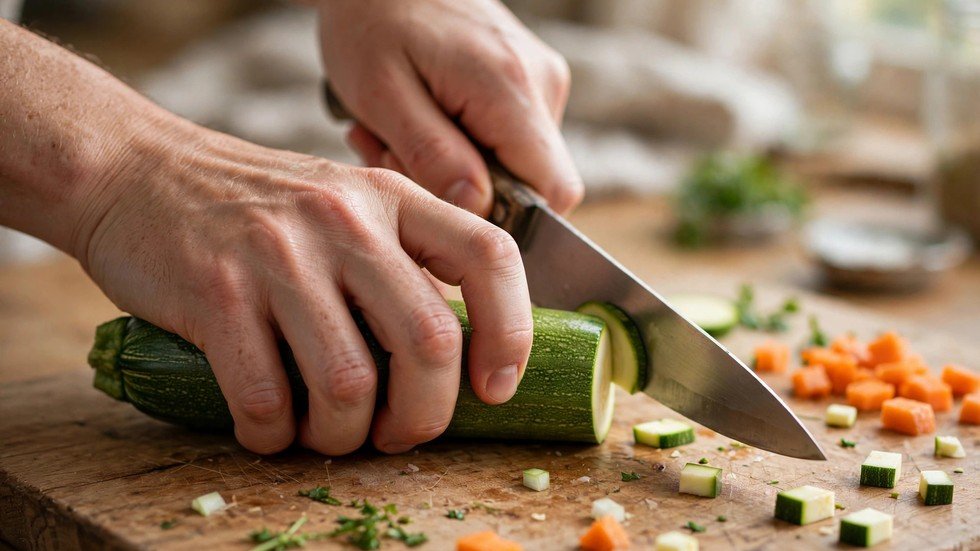
Step 2: Learn the claw grip with your guiding hand. Curl the fingertips of your non-knife hand under, like a cat’s claw, so your knuckles face outward and your fingertips tuck safely behind them. Rest the flat side of the blade against your knuckles. Now the knife rides along your knuckles as a guide, and your fingertips are physically impossible to cut — the blade would have to pass through your knuckles first. This is the single most important safety technique in this guide. Practice it slowly until it feels automatic.
Step 3: The chop — rough, fast, rustic. The chop is for when size doesn’t matter much: mirepoix for stock, vegetables going into a long-cooked stew. Anchor the tip of the knife on the board, keep your claw hand on the food, and bring the blade down in a rocking motion, lifting the handle end while the tip stays down. Cut into rough, uneven pieces. Why this cut exists: speed. When food cooks for an hour, precision is wasted effort.
Step 4: The dice — even cubes for even cooking. First slice the vegetable into even planks, stack the planks and cut them into sticks (batons), then cut across the sticks into cubes. For a classic medium dice, aim for roughly ½-inch cubes. Here’s the why that matters: uniform pieces cook at the same rate. Uneven dice means some pieces are mushy while others are raw — even sizing is the secret behind restaurant-quality sautés and soups.
Step 5: The mince — as fine as it goes. Mincing is dicing taken to the extreme, usually for garlic, ginger, and herbs. For garlic: crush the clove with the flat of the blade to loosen the skin, then rock the knife over it repeatedly, gathering the pile back together with the blade as you go. Keep the tip anchored and let the curved blade do the rocking — your wrist barely moves. Why mince instead of just chopping? Mincing ruptures more cell walls, releasing more flavor — that’s why minced garlic tastes so much stronger than sliced garlic in the same dish.
Step 6: The julienne — elegant matchsticks. Trim the vegetable into a rectangle, slice it into thin planks (about ⅛ inch), stack them, and slice lengthwise into thin sticks about 2 inches long. Carrots, bell peppers, and zucchini julienne beautifully. The why: julienne cuts maximize surface area, so vegetables cook fast and absorb dressings and sauces brilliantly — that’s why restaurant stir-fries and salads use them.
Step 7: The slice — clean, even, controlled. For slicing (potatoes, tomatoes, cucumbers), the key is letting the knife do the work: use long, smooth strokes, pulling the blade back toward you slightly with each cut, rather than pressing straight down. Pressing down crushes; drawing the blade slices. Thin, even slices cook evenly and look professional — and for something like a potato gratin, even slices are the difference between perfect and half-raw.
Step 8: Practice the safety rules until they’re reflex. Never cut toward your body. Never try to catch a falling knife — step back and let it fall. Carry a knife with the blade pointing down at your side, never waving it while you talk. Keep your eyes on the blade while cutting. These sound obvious until the day you’re distracted, and that day is exactly when they save you.
Pro Kitchen Tips for Knife Skills for Beginners
- A sharp knife is safer than a dull one — here’s the physics. A sharp blade bites into food with light pressure and goes exactly where you aim it. A dull blade needs force to cut, and force plus a slipping blade is how accidents happen: the knife slides off the onion skin and into your hand. Sharpen your knife and you’re not being fancy — you’re being safe.
- Hone before every session, sharpen a few times a year. Honing with a steel straightens the edge’s microscopic bend (ten seconds, no skill needed). Actual sharpening removes metal to create a new edge — a whetstone or a professional service a few times a year is plenty for a home cook.
- Cut a flat side first on round vegetables. An onion half, a potato, a bell pepper — everything round wants to roll. Slice off one side to create a stable flat base before you start cutting in earnest. This one habit prevents more slips than any other.
- Slow is smooth, smooth is fast. Professionals look fast because every motion is efficient, not because they’re rushing. Practice slowly with the claw grip and good form; speed arrives on its own. Rushing with bad form is how you practice cutting yourself.
- Keep your knife and board dry-ish as you work. Wet hands, wet handles, and wet boards slip. A quick wipe of your hands on a towel between vegetables takes two seconds and keeps your grip solid.
- Tuck the habit into real cooking. Don’t do drills for their own sake — pick a recipe that needs an onion diced and a carrot julienned, and practice on dinner. You’ll learn faster when the practice has a delicious payoff.
Troubleshooting Advice
- The knife keeps slipping off onion or tomato skin. Cause: a dull blade — the skin is the ultimate sharpness test. Fix: hone or sharpen before you continue. No technique compensates for a dull edge on slippery skins.
- Your cuts are wildly uneven. Cause: rushing, or your guiding hand drifting. Fix: slow down, re-establish the claw, and watch the knuckle the blade rides against — that knuckle sets the width of every cut. Consistent knuckle position equals consistent cuts.
- Your hand and wrist ache. Cause: death-gripping the handle or pressing down hard. Fix: loosen your grip — the pinch grip should be firm but relaxed — and let the blade’s weight and sharpness do the cutting. If you’re muscling it, your knife is dull.
- Herbs turn into a bruised, black mess. Cause: pressing and chopping too aggressively, or a dull blade crushing instead of cutting. Fix: use a sharp knife and a light rocking motion, and chop herbs last, right before using them. A sharp edge severs cleanly; a dull one bruises.
- You’re scared of the knife. Cause: usually one bad cut in the past, or a dull knife that feels unpredictable. Fix: start with the claw grip on something soft and forgiving, like a mushroom or a peeled potato, and go slowly. Fear fades fast once your hands learn that the knuckle-guide system genuinely keeps fingertips out of the way.
Knife Skills for Beginners FAQs
What’s the one knife a beginner should buy first?
An 8-inch chef’s knife from a reputable budget brand. It does everything in this guide. Skip the giant knife block sets — most of those knives will sit unused. One good chef’s knife, kept sharp, outperforms a drawer full of dull specialty blades.
How often should I sharpen my knife?
For a home cook cooking most days: hone with a steel before each use, and sharpen properly two to four times a year. The tomato test tells you when — if the knife slides on tomato skin instead of biting in, it’s time.
Is the claw grip really necessary, or just a chef thing?
It’s necessary, and it’s not about looking professional. It’s simple geometry: curled fingers put bone between the blade and your fingertips. Every other hand position leaves soft fingertip directly in the blade’s path. It takes one afternoon to learn and protects you for life.
Here’s my promise: spend one afternoon with an onion, a carrot, and this guide, and the cutting board stops being the scary part of cooking. These knife skills for beginners will make your dinners taste better too — because evenly cut food cooks evenly, and evenly cooked food is the quiet foundation of every great home-cooked meal. Now go dice that onion. You’ve got this.
You Might Also Like
A great knife is only the start — see our 10 Kitchen Tools Beginners Actually Need (and 5 to Skip) to build the rest of your beginner kitchen kit.